Pages

Showing posts with label Google. Show all posts

Thursday, August 13, 2015

AXS Map: Crowdsourced Accessibility Reviews of Businesses


AXS Map is an app available for iOS and Android that allows users to rank the accessibility of local businesses. Using the location of the device users can search for nearby businesses and rank the accessibility of the location in very basic terms. More detailed accessibility information and information for people with a wider range of disabilities would improve the app.

While accessibility standards established by the government are exact and technical, AXS Map uses a star rating system. For example, a businesses that is easily accessible to people with disabilities would earn a five star ranking. The app also allows users to rank a business based on the noise level, which can be helpful for people with hearing impairments, and by light which can be helpful for people with visual impairments.

I was recently involved in a "Mapathon" were a group of people used the app to map parts of the city. This experience helped me understand the value of the app, as some businesses had serious accessibility issues such as numerous steps with no ramps.

The data that is inputted through the app or the website can then be viewed by people interested in the accessibility of a business. For example, a person with a physical disability could check the app to make sure that a coffee shop had a ramp.

If the AXS Map platform becomes popular it could even prompt businesses with poor rating to make improvements.

While the concept behind AXS Map is good, the implementation is a little rough. The app is not intuitive to use and can be frustrating. However, it does work once you get familiar with the interface. The app also requires users to enter their email which could steer some users away.

To use AXS Map visit AXSMap.com or download the app for iOS and Android. Click here to download the app for iOS and click here to download the app for Android.

Thursday, May 8, 2014

Google's Project Ara Smartphone has Tremendous Accessibility Potential


Google's futuristic modular smart phone has the potential to dramatically change how we think of electronics. The still unreleased phone call Project Ara has a interior metal structure with slots for different components to connect. For example, modular components could house a camera, battery, touch screen display, or speaker. These components snap into place making a relatively standard looking smartphone. Consumers could purchase components and assemble them to make a personalized smartphone. The phone allows consumers to exchange a component for extra battery power or a more powerful camera depending on the situation.

With such customizable hardware, the Ara phone could adapt to fit the needs of people with various disabilities. If users have a hearing impairment they could add a louder speaker component. Conversely, if a user is deaf there is no need to waste space with a speaker when the space could be used for something more useful. The possibilities are almost limitless. A blind user could possibly opt not to have a touch screen display in favor of a refreshable Braille display. Users with dexterity challenges could add a tactile keyboard.

While Project Ara sounds promising for people with disabilities, the implementation is key. Will third party hardware developers make specialized components for people with disabilities at an affordable price? Can Google successfully configure Android to work properly with any assistive add ons third parties make?  Project Ara phones won't be available for for many months, but the project offers some exciting possibilities.


Click read more below to learn more about Project Ara.

Friday, April 4, 2014

iPad mini, Nexus 7, or Kindle Fire HDX: Which Tablet is Best for People with Dyslexia?


Over the past couple of weeks I have been lucky enough to review three of the most popular tablets- the iPad mini, the Nexus 7, and the Kindle Fire HXD. Instead of focusing on battery life, pixel density, and processor speed, I took a look at the features that would help people with dyslexia and other disabilities. All three tablets have some features that are perfect for dyslexics. To figure out which one is right for you, think about which features are most important to you as you read the reviews.
Overview:

When looking for a tablet for someone with dyslexia, there are a number of important factors that must be considered to make sure you get the features that are most important to the user, and get the best value for your needs. First, you want to consider what the tablet will be used for. Will it be used primarily for reading books and browsing the web, or will it be used to type documents, read email, and edit movies. 
Generally, for people with dyslexia, it is important that the tablet have built in text-to-speech with a high quality voice. All three of these tablets have text-to-speech, but the way text-to-speech is implemented is different from tablet to tablet. The iPad allows text-to-speech to be activated in a few taps when reading webpages and text in apps including Safari, Mail and many third party apps including The New York Times. The other tablets require a more time consuming process to activate text-to-speech in all apps.

Next, app quality and quantity is also an important consideration. Currently, the iPad is ahead in terms of app support, but the Nexus 7 is not too shabby in terms of third party app selection either. Apple's lead in terms of third party app selection continues to narrow. See the ecosystem and apps section below for more information about app selection. If the person with dyslexia uses Bookshare or Learning Ally, it is important to make sure that the tablet has apps to support those services. Bookshare is a service that provides accessible e-books for people with print disabilities and Learning Ally provides audio books – some with text - for people with print disabilities. Both the Nexus 7 and iPad mini have Bookshare and Learning Ally apps. The iPad does have better Bookshare support than the Nexus 7.

Thursday, April 3, 2014

Apple Announces WWDC 2014: Will Accessibility Enhancements Take Center Stage Once Again?

picture of colorful Apple logo made from varying sized rounded squares

Apple announced that their World Wide Developers Conference (WWDC) will take place from June 2nd - 6th in San Francisco, California. At the event, Apple will preview the future versions of iOS and OS X. It is unknown what these changes will entail, but if history is any indication Apple will preview iOS 8 and OS X 10.10. Consistently, over the past few years Apple has steadily improved the accessibility features of both iOS, which runs the iPhone, iPad, and iPod Touch and OS X, which runs on Mac computers. Last year with OS X 10.9 Mavericks, Apple added Switch Control, large text, VoiceOver enhancements, customizable closed captioning, and enhanced dictation. iOS 7 added Switch Control, improved Siri, and ability for developers to utilize system text-to-speech voices.

At WWDC 2012, Apple devoted precious time during their Keynote to detail improved accessibility features found in iOS 6. With millions of users any accessibility improvements can have a dramatic impact on many users. Hopefully, Apple can continue to improve their current accessibility options while continuing to insure that any possible future devices are also accessible to people with all abilities. For attendees, the venue is fully ADA compliant.

Stay tuned to the Assistive Technology Blog to learn all about how the WWDC 2014 announcements impact accessibility.

Saturday, March 8, 2014

Any Developer Can Now Integrate Fleksy's Accessible Keyboard Into Their iOS App


Fleksy is an alternative keyboard for mobile devices including smartphones, tablets, and even smart watches. Fleksy uses predictive software that will guess which word you meant to type even if you mistype every letter. As long as your close to the right letters Fleksy will be able to correctly guess which word you meant to type. This means you don't even have to look at the keyboard. If Fleksy does make a mistake you can easily swipe through alternative suggestions.

Currently, Apple does not officially support third party keyboards to replace the default keyboard on iOS, but developers can get around this limitation by building an alternative keyboard into their app. Today, Fleksy made it easy for developers to built the Fleksy keyboard into their app. The Fleksy keyboard is now available for any iOS developer who wants to include it in their app. This announcement is very exciting because if developers get on board it will give iOS users the choice of which keyboard to use.

Having Fleksy integrated in apps is also a positive for blind and visually users. Fleksy works well with VoiceOver and because Fleksy is so good at predicting which word you are trying to type being able to see the keyboard is not as important. The Fleksy keyboard is much quicker and easier to type on then the default iOS keyboard especially for VoiceOver users.

Unlike Android were you can download Fleksy and use it will all of you favorite apps, each iOS developer will have to build in support for the keyboard. Hopefully, now that Fleksy is available for all iOS developer Fleksy will become ubiquitous on iOS. If you would like to see Fleksy integrated into one of your favorite apps you could contact the developer and ask for Fleksy integration.

To try out Fleksy download the app for iOS or Android. Fleksy is currently available in select apps such as Launch Center Pro. Click read more below to view images and videos of Fleksy.

Tuesday, January 21, 2014

Google Smart Contacts May Help Monitor Blood Sugar in the Future


Google is rapidly developing new wearable technologies. Google's first attempt at wearable technology, Google Glass, has attracted a lot of press attention, but is still not available on the mass market. They also cost $1,500. Google's next foray into wearable technology maybe less flashy and less expensive, but may have a greater assistive technology impact.

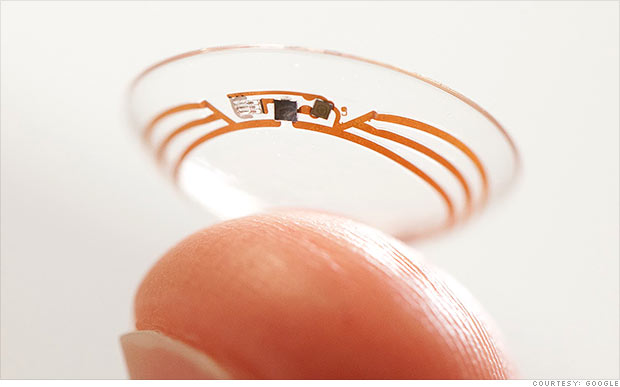
Google's smart contact will sit on the eye like conventional contacts, but do much more. Google's initial idea is to measure blood sugar in tears for diabetics with electronics integrated into the contact. Instead of drawing blood to monitor blood sugar Google's smart contact would analyze blood sugar within tears. This system would eliminate or reduce painful finger pricks and also allow for more frequent testing. A small LED light inside the contact would then illuminate different colors depending on the blood sugar reading.

While this technology is still in development the idea is very exciting. If smart contacts could benefit diabetics maybe Google can adapt them to benefit people with other disabilities or conditions. Could a contact detect sound and give a visual notification to a deaf user? Imagine this, a smart contact for the deaf senses volume of sound and direction and notifies the user. A loud sound off towards a user's right side would illuminate the right LED very brightly while a soft sound off towards a user's left would dimly illuminate the left LED. While Google has only confirmed smart contacts are in testing for blood sugar testing it is exciting to think about the possibilities five or ten years down the line. Hopefully smart contacts for blood sugar monitoring will reach the market sooner than later and will assist people with diabetes.

Click read more to view a short video about Google smart contacts.

Sunday, October 20, 2013

Timely Time Teller App Keeps You Timely


The Timely Time Teller app is a simple app for iOS that gives you repeating alerts at set intervals. When alerts are turned on Timely verbally tells you the time at set intervals. For example, Timely could alert you of the time every 15 minutes. I found this helpful when rushing to get ready for school in the morning, with Timely giving me updates on the time I don't have to worry loosing track of time. When the app says, "seven o'clock" I know I have to be eating breakfast if I don't want to be late. Similarly, I found the app very helpful when bike riding instead of stopping and taking my iPhone out of my pocket Timely tells me the time every 15 minutes. When the iPhone is on silent Timely will vibrate at set times. Unfortunately the vibrate feature isn't very useful because you can distinguish a Timely alert from a text message or email notification. It would be more helpful if the vibration was different from other notifications. In all Timely is extremely simple, but can be a helpful tool. It could be especially beneficial for people with executive function difficulties.

Click read more below to view screenshots of Timely in action. Click here to view Timely in the App Store.

Tuesday, March 12, 2013

Google+ Hangouts Allow Homebound a New Window to the World


Google's social networking site Google+ has made news again for its Hangout video chat feature. This time for providing a new window to the world for people with disabilities that make traveling difficult or impossible. A growing number of photographers are providing videos of different landmarks and attractions. These are not just stagnate videos, users can communicate with the photographer and ask them questions in real time. Also, multiple users can participate in a single session. This feature could also be used to allow people with disabilities to virtually attend a sports game, class, concert, or play. Watch the above video to learn more.

Sunday, March 10, 2013

Google+ Hangouts Now Supports Sign Language Interpreters


While video chatting has helped deaf users communicate with each other, conventional video chatting runs into problem when an interpreter is involved. Google is attempting to solve this problem with its sign language interpreter app for Google+. Google+ is Google's social networking service. Google+ Hangouts now supports sign language interpreters for deaf users. With the app installed the deaf user sees the interpreter in the top right corner of the window.  When the the interpreter speaks for the deaf users, the app recognizes who is speaking and then makes the speaker the focus of the Hangout.

It is encouraging to see Google vigorously improving the accessibility features in Google+.

Thursday, December 27, 2012

Google Play Books Adds Read Aloud Feature


Google Play Books is the Google's ebookstore and companion reader apps. The Android reader app was recently updated to include a text-to-speech read aloud feature. Click here to download the free app for Android. The text-to-speech voice is a little above average but gets the job done. The read aloud feature works with most books in the Google Play store. If you have an Android device be sure to check this app out.

Click read more below to view screenshots of Google Play Books.

Tuesday, November 6, 2012

Ask Google Voice Search How To Spell Unfamiliar Words


Google's recently update Google Voice Search is very useful and extremely fast. There are also a few tricks that can make the app even more useful. One trick is to ask Google Voice Search "how do you spell..." Google will quickly return the correct spelling of the word and speak the spelling aloud. Unlike Siri, Google Voice Search speaks the spelling back to you so you do not need to look at the screen. This trick is especially useful for people with dyslexia and people who are struggling spellers.

Sunday, November 4, 2012

PDF Expert Review


PDF Expert is an elegant PDF manager, viewer and annotator. The app is available for iPhone, iPad and iPod Touch but the iPhone version and iPad version must be purchased separately. You can easily add PDF to the app by using the "open in" feature. Once you have PDFs in the app you can organize them into folders and sub-folders. The highlight of PDF Expert is its annotation features. PDF Expert allows you to quickly and easily add note, text, signatures, watermark stamps, images from the camera roll or audio notes to any PDF. You can search for a PDF by title or by the contents. PDF Expert also includes a passkey lock feature that allows you to protect your sensitive PDFs. 

Unfortunately, PDF Expert does not include text-to-speech for PDFs. Even PDFs created on the computer cannot be read allowed. Also there is no optical character recognition feature for scanned PDFs. If these features are not important to you than PDF Expert is a great choice because of all the other great features. If text-to-speech is important to you than you may need to look elsewhere.

PDF Expert sells for $9.99 in the App Store. Click here for the iPad version and here for the iPhone and iPod Touch version. Click read more to view screenshots of PDF Expert.

Tuesday, October 30, 2012

Google Search App Updated With Advanced Voice Search Similar to Siri


Google just updated its iOS search app to include advanced voice search. The new feature is similar to Apple's Siri. Click here to download the free app. With the Google Search app you can ask questions by voice and get spoken feedback. The Google app is very quick and the voice recognition is accurate. It is almost indential to the voice search included in Android 4.1 Jelly Bean. It is able to answer a broad range of questions and always has Google search results to fall back on. The Google app cannot read text messages, call people, set reminders, dictate notes, set alarms or be used from the lock screen like Apple's Siri. The Google app is still great for asking questions and getting good answers. Also for people without Siri the Google app is a great alternative. 

Watch the video above to see Google voice search in action. Click read more below to view screenshots of the Google Search app in action.

Sunday, October 7, 2012

Assistive Touch Improvements in iOS 6


Apple's iOS 6 improves on the Assistive Touch feature that was originally introduced in iOS 5. Assistive Touch allows people with physical disabilities  to use an iPhone, iPad or iPod Touch. People with physical disabilities may not be able to use two fingers to pinch or to zoom, or may not be able to double tap a button, but Assistive Touch makes these tasks easier. Among the improvements are quick access to Siri, multitasking and screenshots. Assistive Touch still gives users the ability to make custom gesture. Assistive Touch now is compatible with VoiceOver so you can use both features at the same time. To activate Assistive Touch go to Settings > General > Accessibility > Assistive Touch. Click here to learn more about Assistive Touch. Watch the above video to learn more. Click read more below to view screen shots.

Tuesday, September 4, 2012

IBM Sees Watson As Supper Powered Siri Down the Road


IBM's supper computer Watson who beat human competitors at Jeopardy! may answer your voice questions in a few years. IBM sees Watson powering a smartphone app that would act like a supper smart Siri. The app would answer your complex spoken questions in seconds. Not only would Watson be able to pull up facts quickly but it would be able to offer data driven advice for complex problems. The prospect of a Watson app is very existing but is still many years off. A Watson app would be like having a voice activated supper computer in your pocket. Watch the above video to see Watson playing Jeopardy!

Unfortunately, the technology for such a large scale role out of this system is years away but it is still fun to know whats coming.

Wednesday, April 25, 2012

Free Bookshare App For Android


Bookshare recently released Go Read for Android devices. Go Read is the Android version of Bookshare's app for iOS call Read2Go.  The app is free and compatible with a number of Android 2.2 or higher phones and tablets. Features include direct access to Bookshare's library of accessible books, text-to-speech with synced sentence by sentence highlighting and the ability to read ePub books. To learn more about how to become a Bookshare member click here. To download Go Read click here. Click read more below to view screen shoots of Go Read in action.

Tuesday, April 10, 2012

Google Self-Driving Car For the Blind


Google has been developing a self-driving car for a two years. Over the two years of testing the cars they have logged over 200,000 miles. The car has numerous sensors and an on board computer that can drive the car to a destination with out human intervention. In the above video the Google Self-Driving Car drives a legally blind man around town. Click here to watch the audio described version. The car can recognize stop signs, red lights, hazards and pretty much anything else. If the car makes a mistake the driver can hit the break or turn the wheel to control the car. In many states self-driving cars are not street legal. The Google Self-Driving Car is not available for purchase but offers a look into the future. Click read more below to learn more about the self-driving car.

Wednesday, February 15, 2012

Read PDF Files Aloud with vBooks PDF Voice Reader


vBooks PDF Voice Reader is an app for iPhone, iPod Touch and iPad that reads PDFs aloud using text-to-speech. The app has a similar interface to iBook. vBooks PDF Voice Reader comes with a male and female text-to-speech voice included with app. The included text-to-speech voices sound good and are easy to understand. To read a PDF simply tap on the front page of the PDF from the bookshelf and then press the red play button on the bottom of the screen. The text can be read at speeds of 100 words per minute all the way up to 240 words per minute. The app has a cursor that highlights the word being read and you can drag the cursor around to start reading a different part of the PDF. The app also has navigation features such as search, thumbnails and sliders. PDFs can be imported into vBooks PDF Voice Reader by using the "open in" feature from apps such as mail or iTunes sync. vBookz does not have OCR capabilities so images with text will not be compatible. Another downside is that there is no bookmarking feature and the app will not remember where you left off so you will have to find where you left off each time. To learn more about OCR click here. vBookz PDF Voice Reader costs $4.99 in the App Store.

vBookz requested the following be included in the review,
"We're open for requests and suggestions. Not everything can be implemented, but it is important for us to improve our products as much as we can".

For more information about zBookz click read more below.

Friday, December 30, 2011

ChromeVis: Free Tool for Chrome Users With Low Vision


ChromeVis is a simple Chrome extension for users with low vision. ChromeVis is simple to use and has many customization options. To use ChromeVis highlight the text you want magnified and then click on the ChromeVis icon in the top right of your Chrome window. To customize the appearance of ChromeVis right click on its icon and select options. To download ChromeVis for free click here.

Sunday, December 18, 2011

Google Dictionary Defines Any Word on the Web


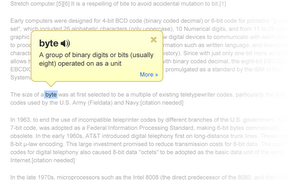
Google Dictionary is a free extension available for Google Chrome. To download the extension click here. Once downloaded simply double click on any word on a web page to view its definition or hear the word read aloud. Google Dictionary is perfect for quickly looking up unfamiliar words. To learn about other Chrome extensions click here.